


English Practice Question and Answer
8 Q: Select the most appropriate option to fill in the blank.
My grandfather was a farmer and he ___________three acres of land.
1107 06450da38508d9a21f7927c53
6450da38508d9a21f7927c53My grandfather was a farmer and he ___________three acres of land.
- 1cultivatedtrue
- 2advancedfalse
- 3grownfalse
- 4culturedfalse
- Show AnswerHide Answer
- Workspace
- SingleChoice
Answer : 1. "cultivated"
Q: Given below is a word, followed by three sentences that consist of that word. Identify the sentences(s) that best express(es) the meaning of the word. Choose option 5 ‘None of the above’ if the word is not suitable in any of the sentences.
Ascent
A. She made her first successful ascent of Everest last year.
B. She nodded her ascent to the proposal.
C. His ascent to power was rapid and unexpected.
1107 064d4ccafbd50dd8e2e11c645
64d4ccafbd50dd8e2e11c645- 1Only Cfalse
- 2Only Afalse
- 3A and Ctrue
- 4B and Cfalse
- 5None of the abovefalse
- Show AnswerHide Answer
- Workspace
- SingleChoice
Answer : 3. "A and C"
Q:You have eight brief passages with 10 questions following each passage. Read the passages carefully and choose the best answer to each question out of the four alternatives
There is a general consensus that ‘International Understanding’ need to be taught as a separate subject at the school stage as that would add to the curricular load which is already too heavy. Instead it should be woven into the curriculum and the numerous opportunities that present themselves while teaching normal school subjects may be intelligently and imaginatively used by the teacher to promote International Understanding.
The school subjects which can be most profitably used for this purpose are History, Geography, Civics, Economics, Sociology, Political Science, Social Sciences, Languages as well as Physical and Life Sciences. However, at the higher education level, international education can be prescribed as a separate subject of study. In fact, the present situation in India broadly conforms to this consensus so far as the school stage is concerned.
At the under-graduate and the post-graduate levels, courses of study in subjects like History, Geography, Economics, Political Science, International Relations, International Law and International Organization have been prescribed by most of the universities and these contain content which has a direct or indirect bearing on promoting UNESCO ideals
On reading Para 1, it can be inferred that
1106 063aecaeef6152c6d817fe4e5
63aecaeef6152c6d817fe4e5- 1all the subjects at school level may not be helpful in promoting International Understanding.false
- 2school subjects may be used creatively to promote International Understanding.true
- 3international Understanding may be treated as a separate subject in schools.false
- 4the school curriculum is too heavy to incorporate International Understanding.false
- Show AnswerHide Answer
- Workspace
- SingleChoice
Answer : 2. "school subjects may be used creatively to promote International Understanding. "
Q:In the following passage, some words have been deleted. Read the passage carefully and select the most appropriate option to fill in each blank.
A group of researchers has (1) ______ that pleasure and positive states of mind are better for our health. This new intellectual approach to health is not only more powerful, but also has no side effects. Central to this claim are recent findings that even getting an education may add as much as 10 years to your (2) ______. That is why National Geographic featured John de Rosen in its book The Incredible Machine, which discussed old age. De Rosen, an artist, continued to paint until the week he died at age 91. The book notes: "Some scientists believe that retirement to a (3) ______ lifestyle initiates or aggravates medical problems, thus shortening life. According to a study of retired people, adults over 65 can learn a (4) ______ skill, like oil painting, as readily as younger students." So retiring from a job in a sense means retiring from life unless (5) ______ by some other, preferably new activity. Select the most appropriate option to fill in blank number 3.
1106 0641996f55bff3d098df656eb
641996f55bff3d098df656eb- 1complimentaryfalse
- 2sanitaryfalse
- 3sedentarytrue
- 4segmentaryfalse
- Show AnswerHide Answer
- Workspace
- SingleChoice
Answer : 3. "sedentary"
Q: Select the option that can be used as a one-word substitute for the given group of words.
An instrument for detecting an earthquake
1106 0644264142d621da116a7955e
644264142d621da116a7955e- 1Electrographfalse
- 2Seismographtrue
- 3Magnetographfalse
- 4Spectrographfalse
- Show AnswerHide Answer
- Workspace
- SingleChoice
Answer : 2. "Seismograph"
Explanation :
A seismograph is an instrument used for detecting and recording earthquakes.
Q:Select the most appropriate ANTONYM of the given word.
Comic
1106 064634bb1f75f230a7a77f113
64634bb1f75f230a7a77f113- 1Nativefalse
- 2Costlyfalse
- 3Tragictrue
- 4Emptyfalse
- Show AnswerHide Answer
- Workspace
- SingleChoice
Answer : 3. "Tragic"
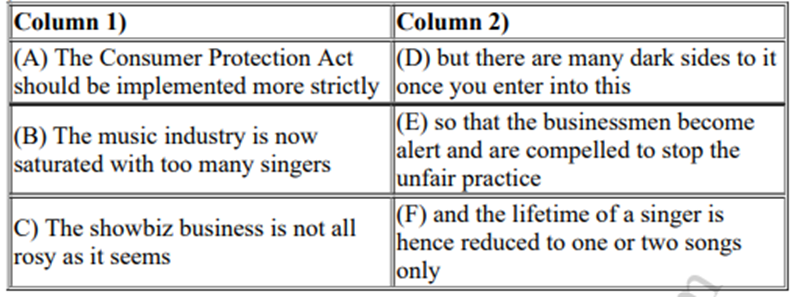
Q:In the following question, two columns are given containing three phrases each. In the first column, phrases are A, B, and C, and in the second column, the phrases are D, E, and F. A phrase from the first column may or may not connect with a phrase from the second column to make a grammatically and contextually correct sentence. There are five options, four of which display the sequence(s) in which the phrases can be joined to form a grammatically and contextually correct sentence. If none of the options forms a correct sentence after combination, select ‘None of these’ as your answer.
1106 064edf3b93be218b6cddbe323
64edf3b93be218b6cddbe323
- 1A-Ffalse
- 2B-F, C-Dfalse
- 3A-E, B-F and C-Dtrue
- 4B-F, C-Efalse
- 5None of thesefalse
- Show AnswerHide Answer
- Workspace
- SingleChoice
Answer : 3. "A-E, B-F and C-D"
- Show AnswerHide Answer
- Workspace
- SingleChoice