


Practice Question and Answer
8 Q: समावेशी इंटरनेट सूचकांक 2020 में भारत का रैंक क्या है?
2154 05e6e0eff2b7daf7d8e1cffe9
5e6e0eff2b7daf7d8e1cffe9- 167false
- 298false
- 346true
- 456false
- Show AnswerHide Answer
- Workspace
- SingleChoice
Answer : 3. "46"
Q: What is the purpose of Spanning Tree Protocol in a switched LAN? 2154 05b5cc7e5e4d2b4197775192d
5b5cc7e5e4d2b4197775192d- 1To provide a mechanism for network monitoring is switched environmentsfalse
- 2To prevent routing loops in network with redundant pathsfalse
- 3To prevent switching loops in networks with redundant switched pathstrue
- 4To manage the VLAN database across multiple switchesfalse
- Show AnswerHide Answer
- Workspace
- SingleChoice
Answer : 3. "To prevent switching loops in networks with redundant switched paths"
Explanation :
Answer: C) To prevent switching loops in networks with redundant switched paths Explanation: The Spanning Tree Protocol (STP) was designed to stop layer 2 loops. All Cisco switches have the STP on by default.
Q: Which compound is a nonelectrolyte? 2154 05b5cc6a8e4d2b4197774ce6c
5b5cc6a8e4d2b4197774ce6c- 1C2H6Otrue
- 2HClfalse
- 3Na2CO3false
- 4NaClfalse
- Show AnswerHide Answer
- Workspace
- SingleChoice
Answer : 1. "C2H6O"
Explanation :
Answer: A) C2H6O Explanation: C2H6O is a Non-electrolyte. An electrolyte is a compound that conducts an electric current when it is in an aqueous solution or melted. In order to conduct a current, a substance must contain mobile ions that can move from one electrode to the other. All ionic compounds are electrolytes. When ionic compounds dissolve, they break apart into ions which are then able to conduct a current ( conductivity ). Even insoluble ionic compounds such as CaCO 3 are electrolytes because they can conduct a current in the molten (melted) state. A nonelectrolyte is a compound that does not conduct an electric current in either aqueous solution or in the molten state. Many molecular compounds, such as sugar or ethanol, are nonelectrolytes. When these compounds dissolve in water, they do not produce ions. Electrolytes are of 3 types ---- Strong Electrolytes, Weak Electrolytes and Non Electrolytes. Strong Electrolytes ---- Compounds which completely dissolves. ( NaCl, Na2Co3, HCl ) Weak Electrolytes ----- Compounds which do not completely dissolves. Non Electrolytes ------ Compounds which do not dissolves at all.
Q: Name the company that has recently created the world’s smallest magnet using a single atom which can store one bit of data on it. 2154 05b5cc71be4d2b4197774f553
5b5cc71be4d2b4197774f553- 1TCSfalse
- 2Microsoftfalse
- 3IBMtrue
- 4Infosysfalse
- Show AnswerHide Answer
- Workspace
- SingleChoice
Answer : 3. "IBM"
Explanation :
Answer: C) IBM Explanation: A team of researchers at IBM has created the world’s smallest magnet using a single atom which can store one bit of data on it.
Q: 12 लोग किसी काम को 12 दिनों में कर सकते हैं । यदि 6 लोग 6 दिन काम करके काम छोड़ दे, तो काम को खत्म होने में अतिरिक्त कितने दिन लगेंगे?
2154 05ef5b36a6306ab2a81aacabd
5ef5b36a6306ab2a81aacabd- 112 daysfalse
- 224 daysfalse
- 33 daysfalse
- 46 daystrue
- Show AnswerHide Answer
- Workspace
- SingleChoice
Answer : 4. "6 days "
Q: How many Covalent Bonds can Nitrogen form 2154 05b5cc6b8e4d2b4197774d67a
5b5cc6b8e4d2b4197774d67a- 12false
- 23true
- 34false
- 41false
- Show AnswerHide Answer
- Workspace
- SingleChoice
Answer : 2. "3"
Explanation :
Answer: B) 3 Explanation: Nitrogen (N2) forms Three Covalent Bonds to become stable. Here the Atmomic Number of Nitrogen is 7. Because there are 2 electrons in the first orbital and 5 in the second and you still have space for 3 more. So it shares, 3 to get the stable octet. Therefore, there are 3 covalent bonds in N2.
Q: यदि $$ {x^{a^{3}}}.x^{b^{3}}.x^{3ab(a+b)}=(2^{5})^{25},a+b=5 $$ है x के लिए मान होगा—
2153 0600e91ea7fb81d03bf730d5a
600e91ea7fb81d03bf730d5a- 12true
- 23false
- 31false
- 40false
- Show AnswerHide Answer
- Workspace
- SingleChoice
Answer : 1. "2"
Q:यहां दिए गया वर्त -ग्राफ एक विशेष वर्ष के दौरान विभिन्न खेलों पर एक देश के खर्च को दर्शाता है। ग्राफ का ध्यानपूर्वक अध्ययन करें और नीचे दिए गए प्रश्न का उत्तर दें।
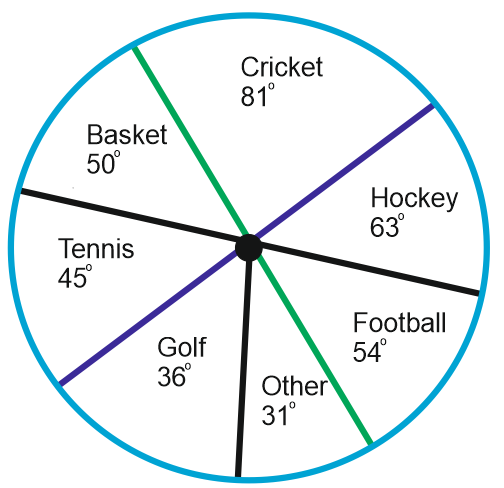
यदि वर्ष के दौरान खेलों पर खर्च की गई कुल राशि 2 करोड़ रु।, एक साथ क्रिकेट और हॉकी पर खर्च की गई राशि:
2153 05d70afe4eb96471d6f364689
5d70afe4eb96471d6f364689- 1Rs. 8,00,000false
- 2Rs. 80,00,000true
- 3Rs. 1,20,00,000false
- 4Rs. 1,60,00,000false
- Show AnswerHide Answer
- Workspace
- SingleChoice
Answer : 2. "Rs. 80,00,000"
Explanation :
undefined